Nineteen steps through a single purchase at a switchgear manufacturer:
the stock warning that started it, three quotations in two currencies,
the landed-cost comparison that reversed their ranking, the award, the
shipment that arrived four weeks late, and the liquidated damages that
followed. Every screen below is the product. Every number in it was
calculated by the product.
About the company in these screens
Northgate Control Systems builds low-voltage switchgear and control
panels, and is entirely invented — the company, its suppliers,
its part numbers, its prices and its quantities. The software is not.
What you are looking at is the real application running on that
example data, screen by screen, in the order the work happened.
The short version
Eight lines, for anyone who has to explain this to somebody else.
The long version — all nineteen steps, with the screens
— is underneath.
The cockpit says order now.
On 20 September, 22 of 121 tracked items are below their reorder
point, each with the cover it has left and the numbers that produced
it. Nobody went looking.
The buying team decides, and the decision is kept.
A 41-minute review closes with every item carrying an outcome and a
reason. The log holds 74 decisions across 56 items and none of them
is unexplained.
One sourcing event holds the whole enquiry.
Four busbar lines, 7,200 pieces, three suppliers, the RFQ, the
quotes, the comparison and the award — under one reference,
NG/RFQ/2026/001.
Landed cost reverses the ranking.
The cheapest quotation is 175,742 SAR below the next one and lands
199,090 SAR above it. That reversal is the difference between a good
decision and a defensible one.
A negotiation round, then a split award.
111,400 SAR comes off the original quotations. 70/30 across two
suppliers, with the reason for each line typed in beside it —
including the 59,727 SAR the second source costs.
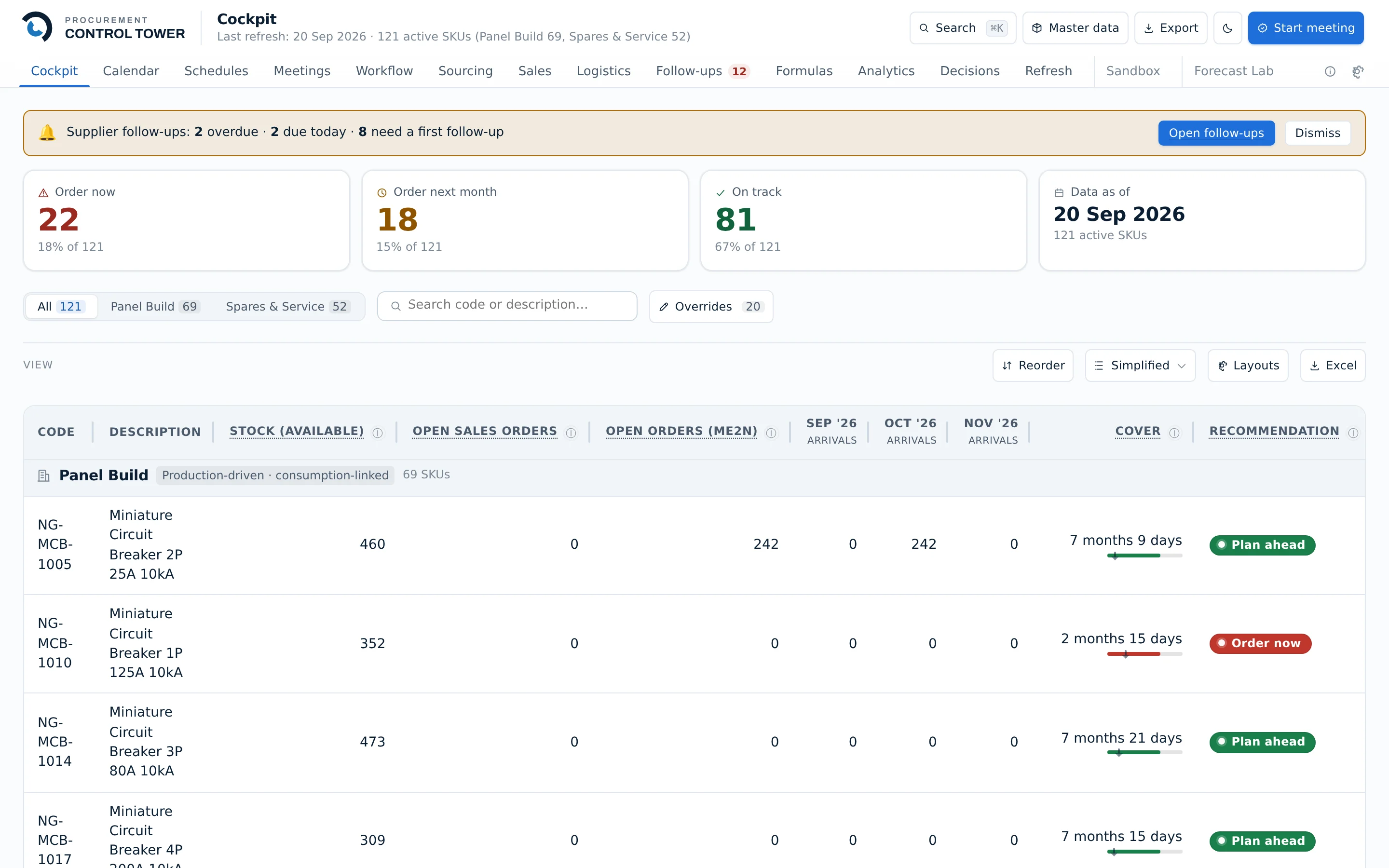
On 20 September 2026 the cockpit has 22 of 121 tracked items at
Order now and 18 more falling due next month. Each
row shows what produced that verdict: stock available, open sales
orders, what is already on order, arrivals booked for the next three
months, and the months of cover those add up to.
NG-MCB-1010 has 2 months 15 days of cover and nothing arriving. That
is the entire argument for ordering it, sitting on the row, before
anyone opens a spreadsheet to build it.
Procurement Control Tower — Cockpit
Tracked parts
121
Order now
22
Order next month
18
On track
81
Step 2 of 19
People decide, in a meeting, on the record
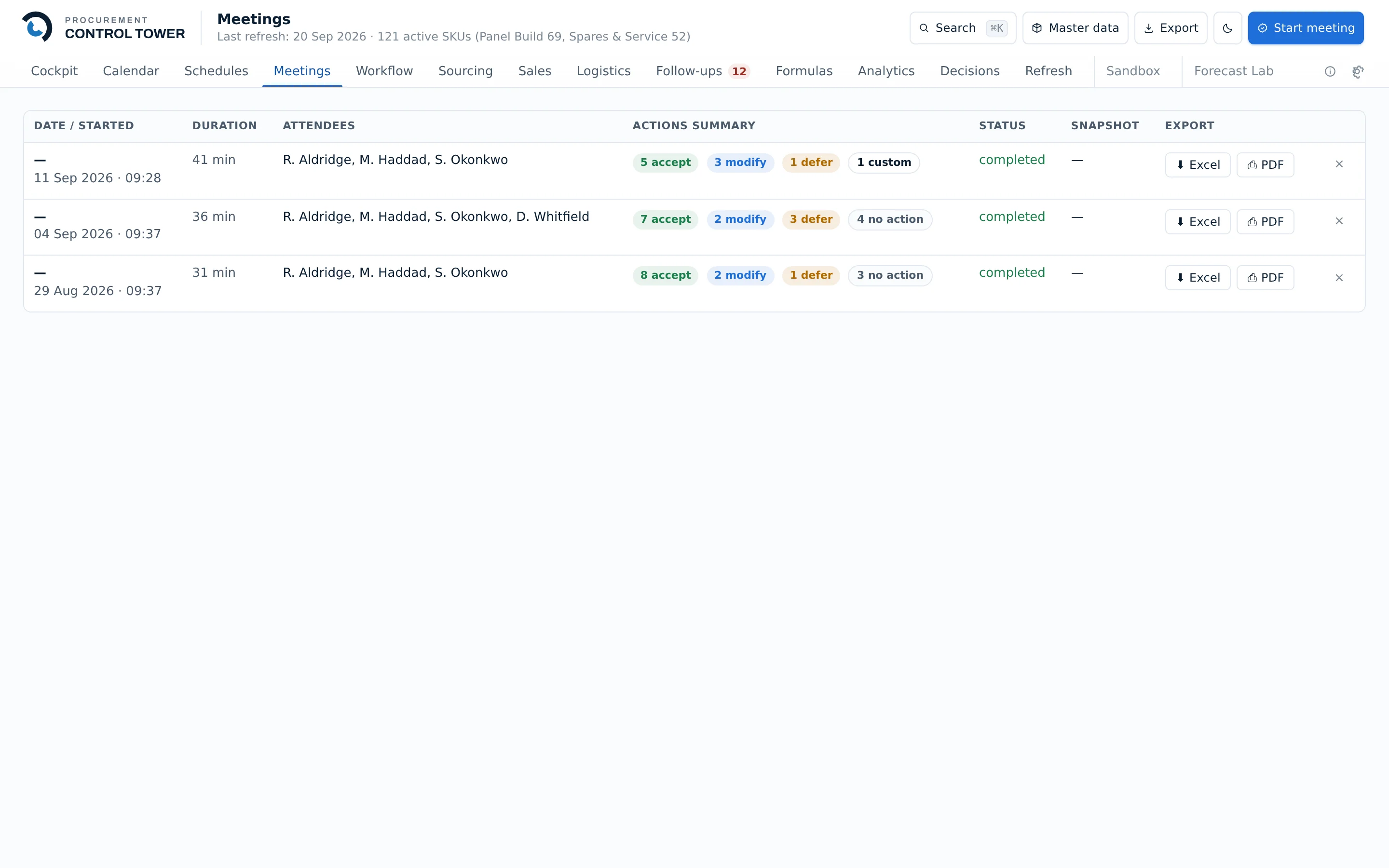
The software does not place orders. It prepares a review: the items
that need a call, the numbers behind each one, and a place to put the
answer. The most recent review ran 41 minutes with three people and
closed with five recommendations accepted, three modified, one
deferred and one replaced with something the meeting invented.
Procurement Control Tower — Meetings
Step 3 of 19
The decision is written down, with its reason
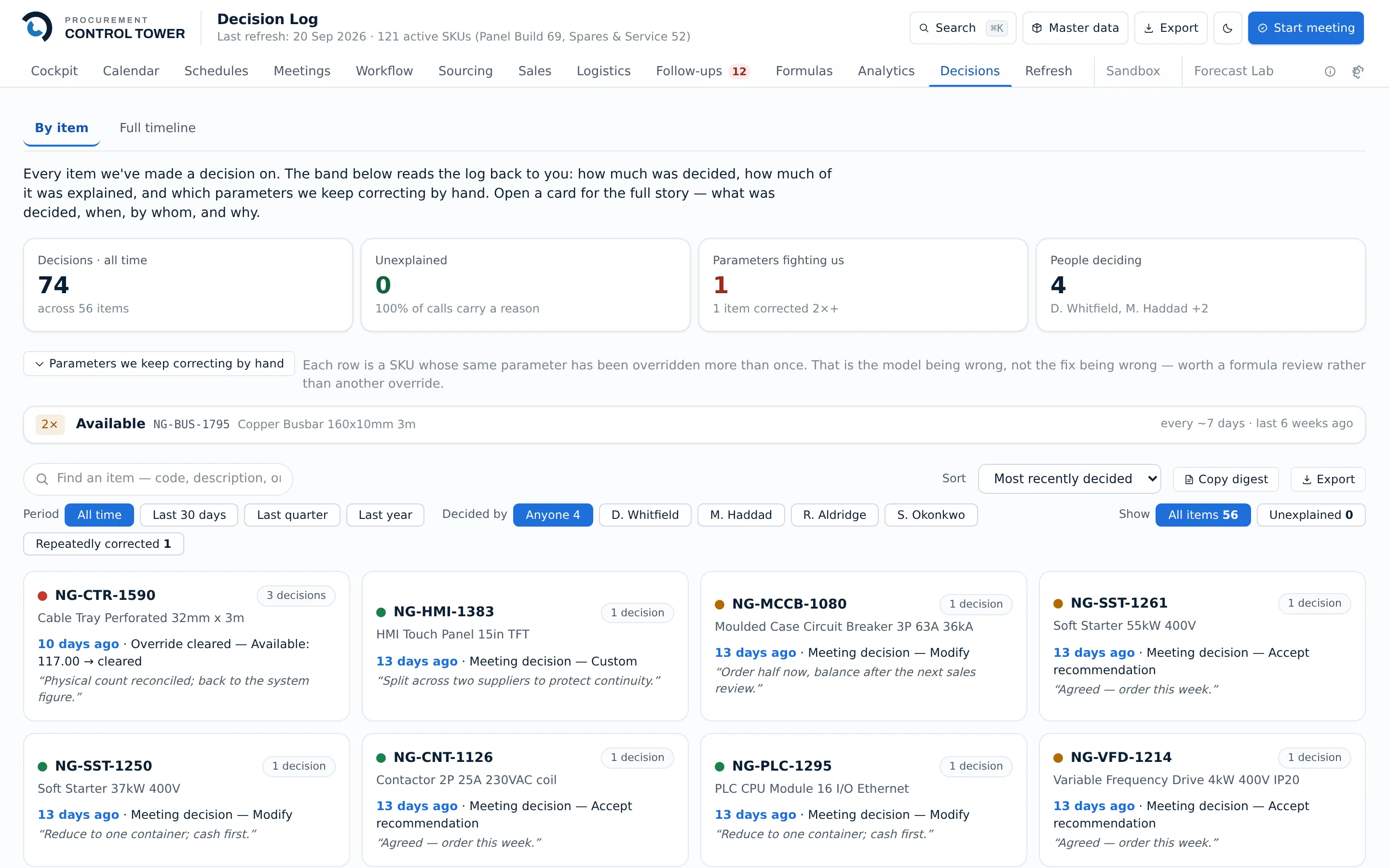
74 decisions across 56 items, four people deciding, and not one of
them unexplained — the log will not take a call without a
reason. Six months later, the question “why did we order half
of this?” has an answer with a name and a date on it.
The log reads itself back, too. It flags the parameters being
corrected by hand over and over: the available quantity on
NG-BUS-1795 has been overridden twice in six weeks, which says
something about the model rather than about the buyer.
Procurement Control Tower — Decision log
Decisions recorded
74
Items covered
56
Without a reason
0
Step 4 of 19
The requirement becomes a sourcing event
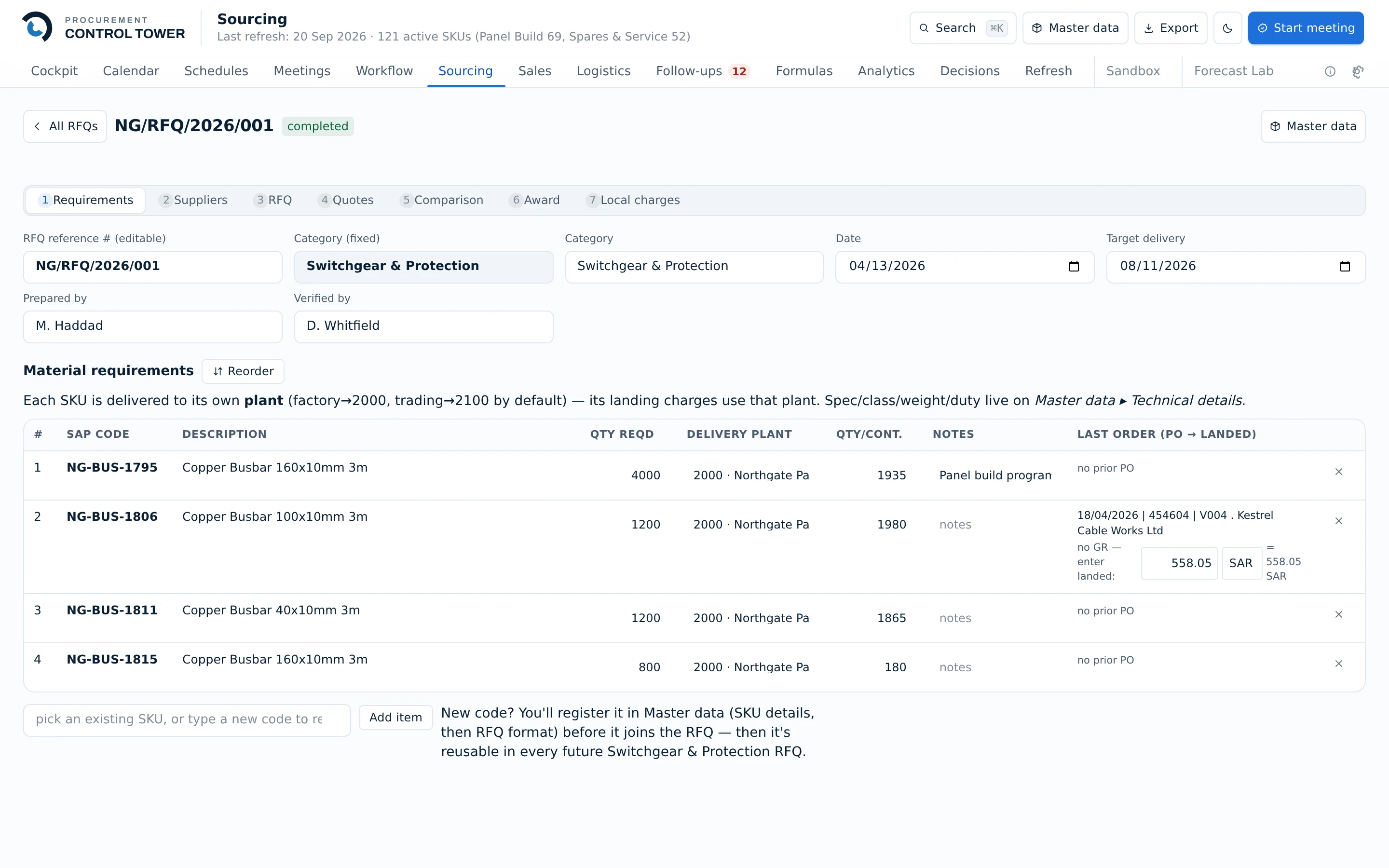
NG/RFQ/2026/001. Category Switchgear & Protection, four copper
busbar lines, 7,200 pieces in total, wanted by 11 August, prepared by
M. Haddad and verified by D. Whitfield. One reference now carries the
whole enquiry through to the award.
The second line already knows what it cost last time — PO
454604, 558.05 SAR landed — so the benchmark is on the screen
before a single quotation arrives. Lines stay in the order the buyer
typed them; Reorder is how that order changes, and
all of it saves in one go rather than one slow write per move.
Procurement Control Tower — Sourcing, Requirements
Step 5 of 19
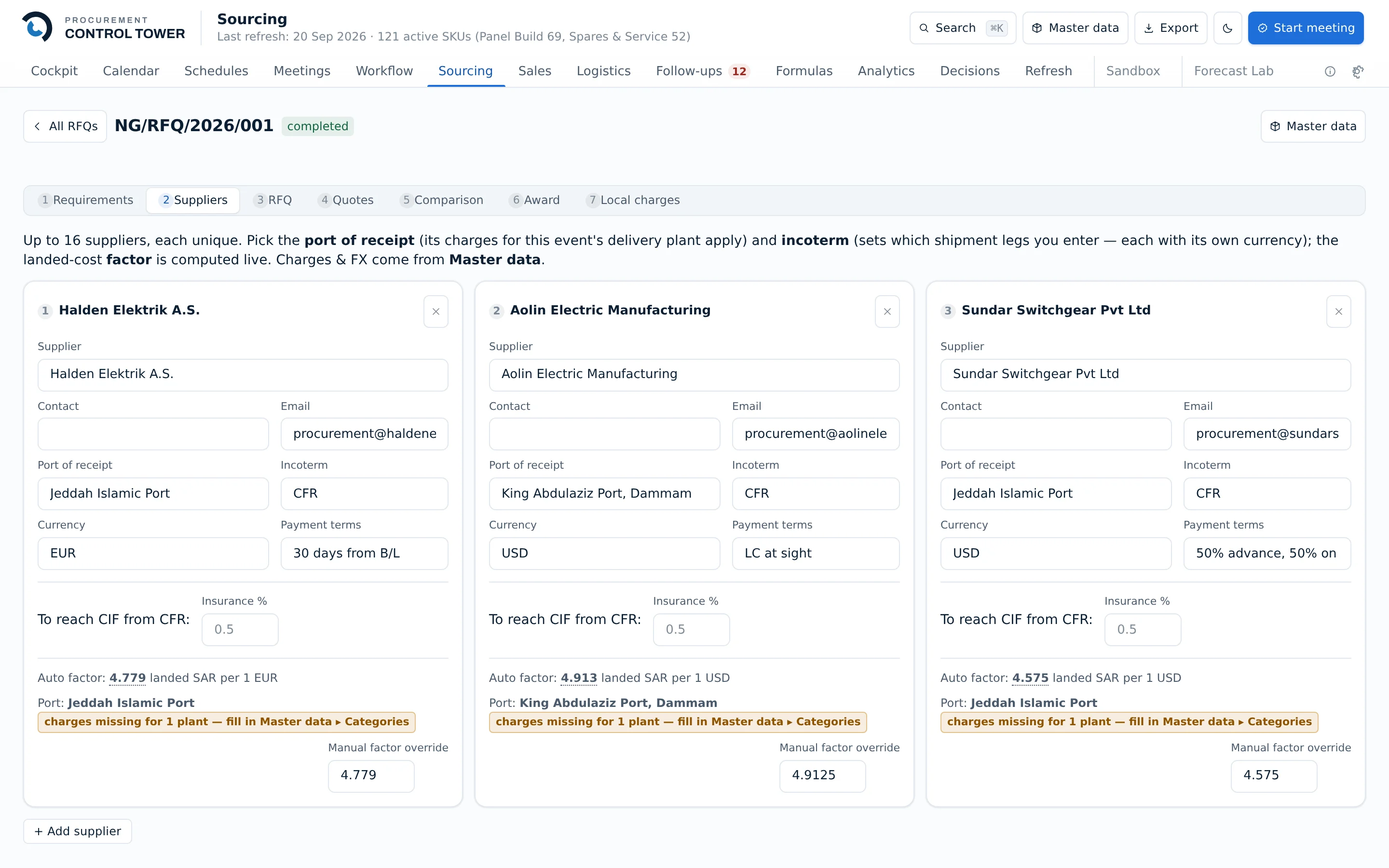
Three suppliers, three sets of terms
Halden Elektrik quotes euros into Jeddah on 30 days from bill of
lading. Aolin Electric quotes dollars into Dammam against a letter of
credit. Sundar Switchgear quotes dollars into Jeddah, half in
advance. All three are CFR, so the same legs of the journey are
theirs and the same legs are Northgate's.
The number to watch is the factor under each card —
4.779, 4.913 and
4.575 landed riyals per unit of that supplier's own
currency. It carries the exchange rate, the freight, the duty and the
charges from port to plant, and it is what will make three
incomparable quotations comparable four steps from now.
Procurement Control Tower — Sourcing, Suppliers
Step 6 of 19
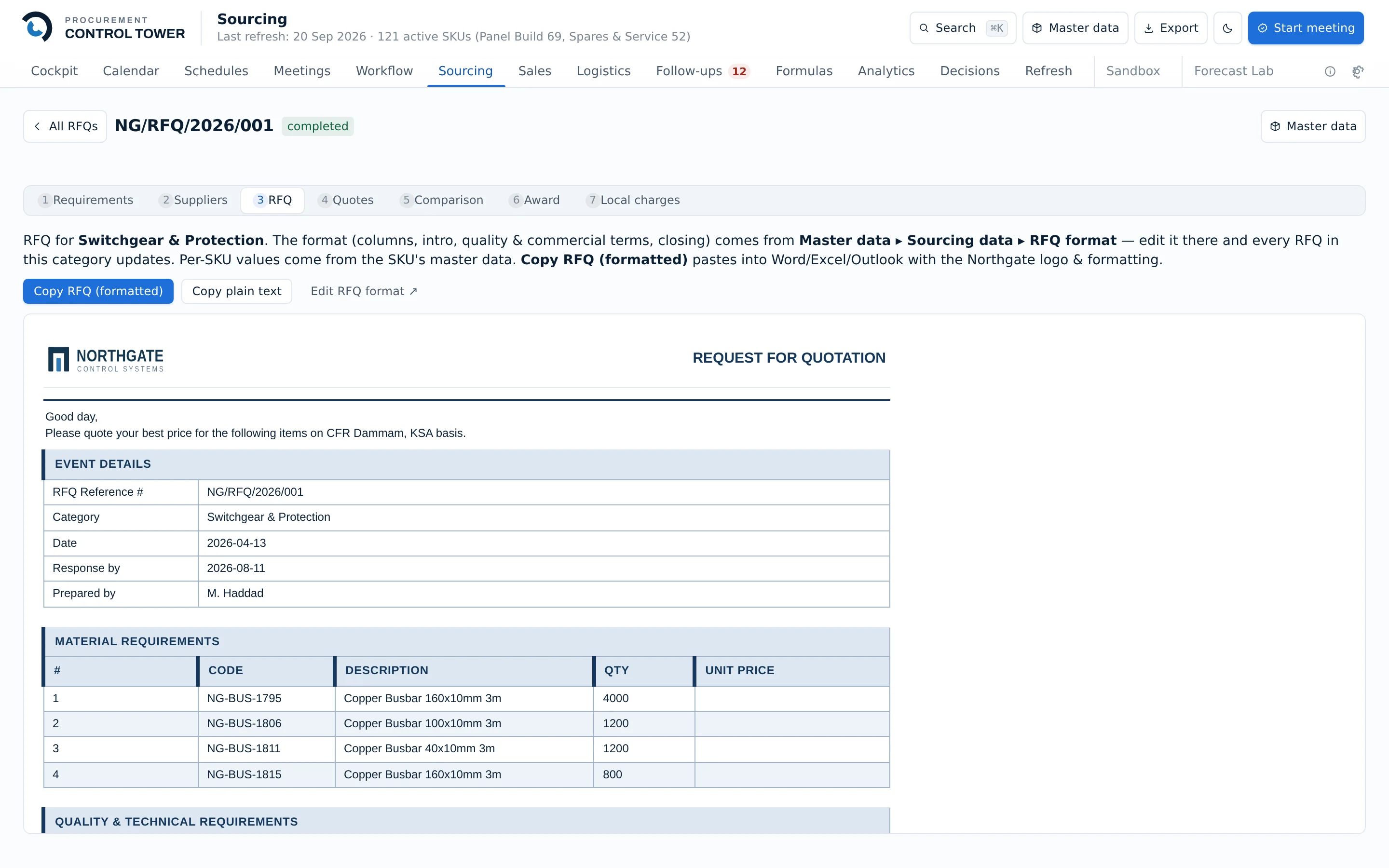
The enquiry goes out on the company's letterhead
One click assembles it: the company's own logo, the event details,
the four lines with their quantities, the quality and technical
clauses, the commercial terms and the closing. Copy RFQ
(formatted) puts the whole document on the clipboard with
its formatting intact, to be pasted straight into an email.
The format is held once per category in master data, not per enquiry.
Change a clause there and every future RFQ in that category carries
it — which is the difference between a template and six
slightly different templates on six people's desktops.
Procurement Control Tower — Sourcing, RFQ
Step 7 of 19
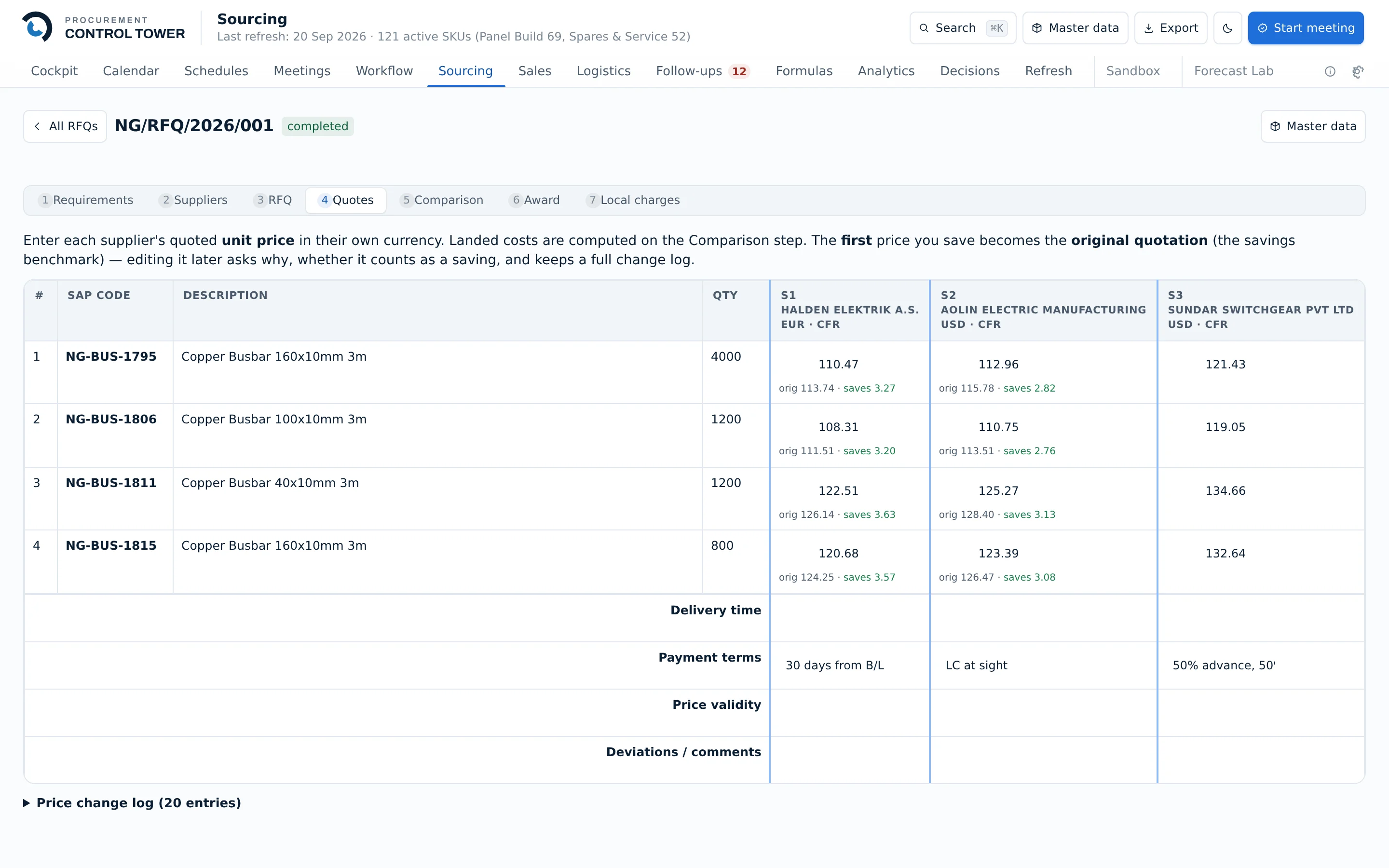
Quotes come back, each in its own currency
Prices are entered exactly as the supplier sent them — euros
from Halden, dollars from Aolin and Sundar — along with the
delivery time, payment terms, validity and any deviation the supplier
noted. Nothing is converted at this point, because converting early
is how the wrong number ends up in the minutes.
The first price saved against a supplier becomes the benchmark and is
never overwritten. That is why each cell here carries a second line:
orig 113.74 · saves 3.27. This screenshot is the
grid after the negotiation of step 10 — the original
quotation is the smaller figure, still there, still the thing any
saving will be measured against. Twenty entries are in this event's
price-change log.
Procurement Control Tower — Sourcing, Quotes
Step 8 of 19
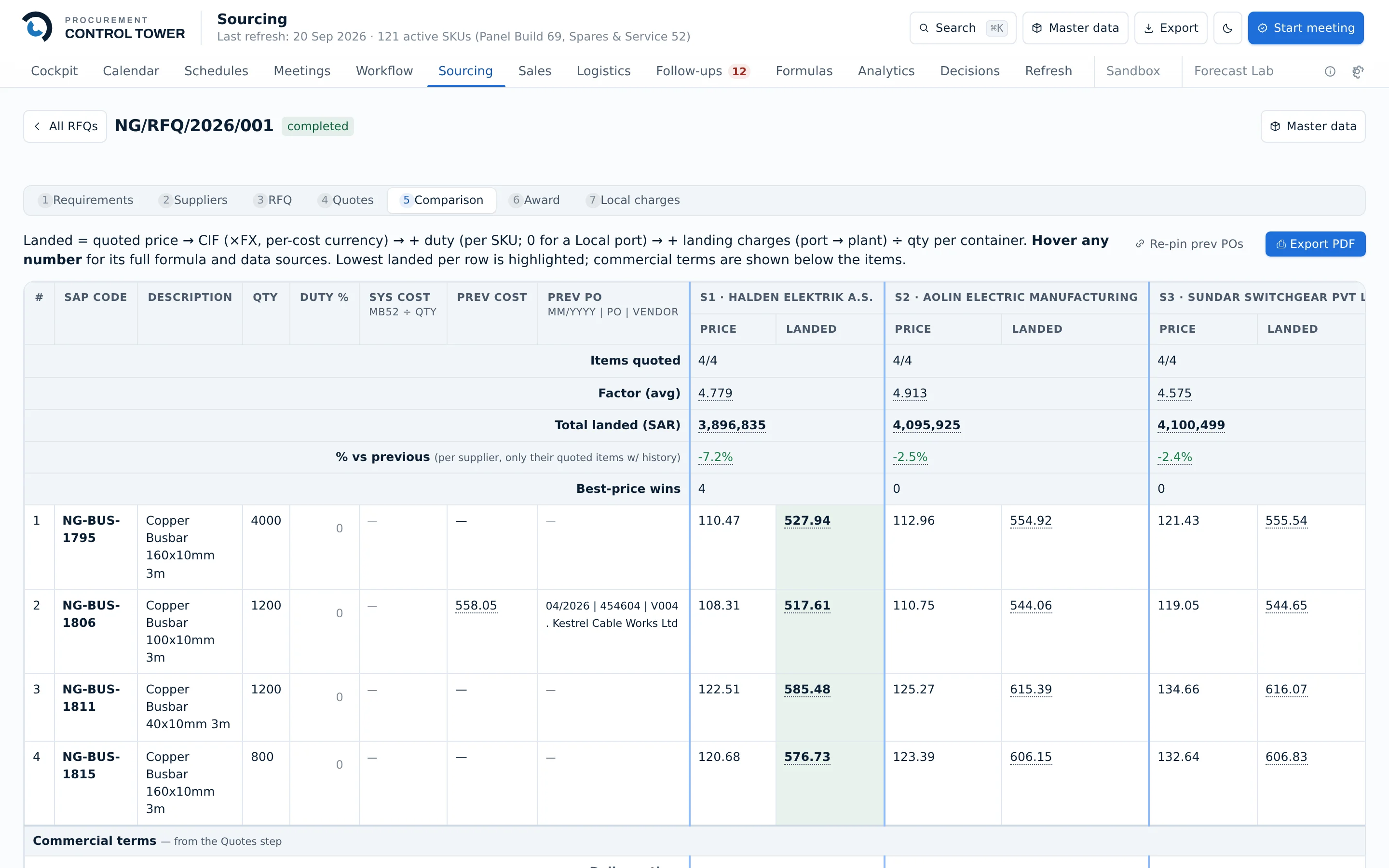
What the material will actually cost
Landed cost is built up in one line, printed at the top of the screen
so nobody has to take it on trust: quoted price, to CIF by exchange
rate in each cost's own currency, plus duty per part, plus the
landing charges from port to plant, divided by the quantity a
container holds. Hover any number and it shows its own formula and
where each input came from.
On the first line, Halden's EUR 110.47 becomes
527.94 SAR landed, and Aolin's
USD 112.96 becomes 554.92.
Procurement Control Tower — Sourcing, Comparison
Step 9 of 19 · same screen
The cheapest quotation is not the cheapest purchase
Converted at the day's rates, Aolin's quotation is the lowest of the
three: 3,126,660 SAR against Halden's 3,302,402 — cheaper by
175,742 SAR. Landed, Halden totals 3,896,835 and
Aolin 4,095,925 — dearer by 199,090 SAR.
Same quotations, opposite answer.
Worth being precise about what the screen shows and what it does not:
the price column holds each supplier's own currency, so the reversal
is not something you can see by eye, line by line. It is visible on
the Total landed row. That is the argument for the
screen existing — comparing quotations across currencies,
incoterms, duty and freight is not a thing anyone eyeballs correctly.
Halden, landed
3,896,835
Aolin, landed
4,095,925
Sundar, landed
4,100,499
Ranking, ex-works
reversed
Step 10 of 19 · back to the quotes
The comparison is what the negotiation is made of
Going back to the suppliers with a landed-cost comparison is a
different conversation from going back with a price list. Halden
moves from 113.74 to 110.47 and Aolin from 115.78 to
112.96. Sundar does not move.
Editing a price that has already been saved asks two questions
— why, and does this count as a saving — and keeps both
answers. The original quotation stays put as the benchmark, which is
the only reason the next step can produce a number anyone should
believe.
Step 11 of 19
Two savings, and they are not the same thing
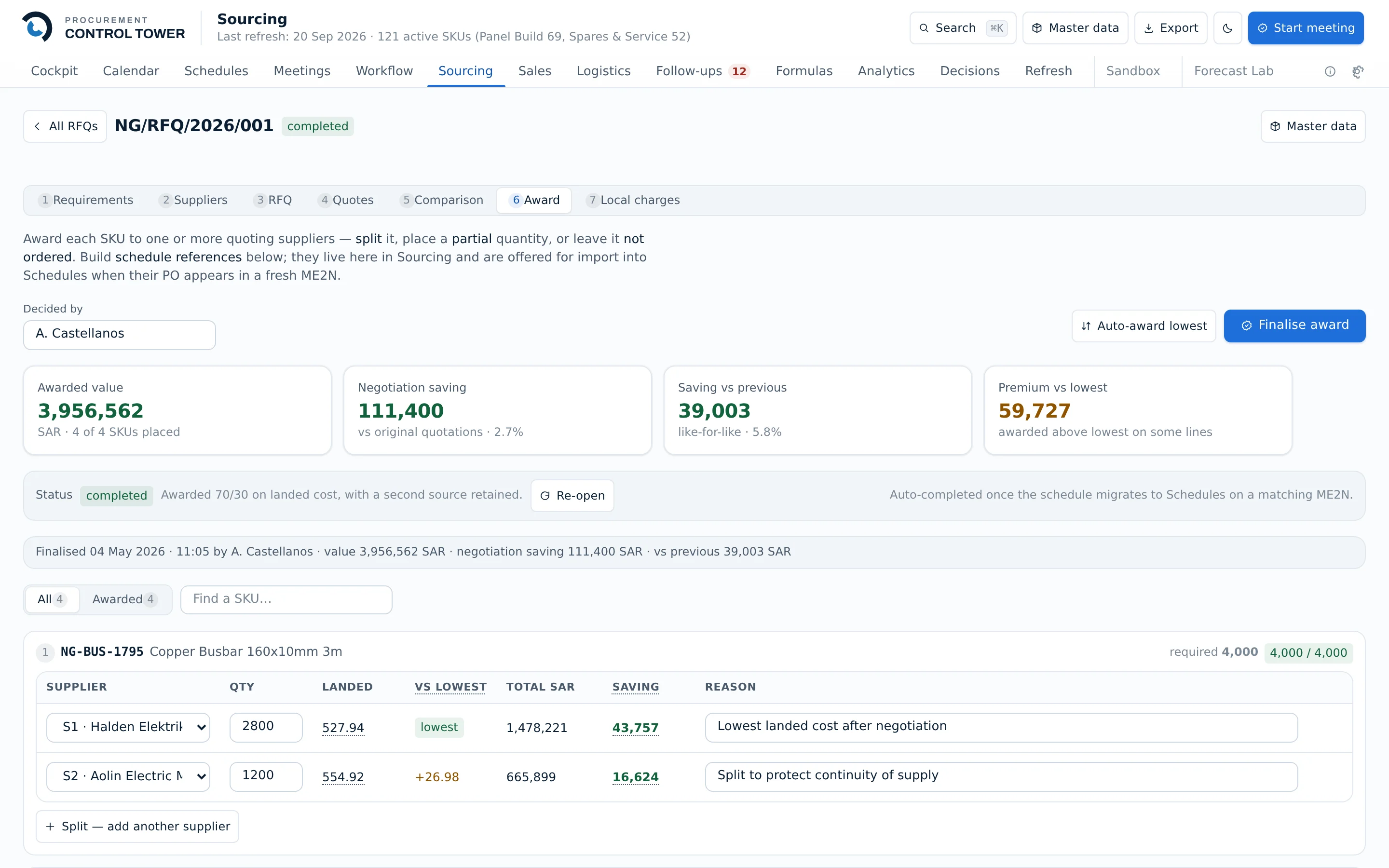
111,400 SAR, or 2.7%, against the original
quotations: what the negotiation moved. 39,003 SAR,
or 5.8%, against what Northgate paid last time, like for like: what
the purchase actually saved the business. Procurement teams are asked
for one number and usually mean the other, so the screen shows both
and says which is which.
Procurement Control Tower — Sourcing, Award
Awarded value
3,956,562
Negotiation saving
111,400
Versus previous
39,003
Premium vs lowest
59,727
Step 12 of 19 · same screen
The award, split, with the reasons attached
The first line goes 70/30. Halden takes 2,800 pieces at 527.94 landed
— 1,478,221 SAR — against the reason “Lowest landed
cost after negotiation”. Aolin takes 1,200 at 554.92 —
665,899 SAR — against “Split to protect continuity of
supply”. Decided by A. Castellanos, finalised at 11:05 on 4 May.
That second source costs 59,727 SAR over awarding
everything to the cheapest landed supplier, and the screen puts the
number in a tile of its own rather than leaving it to be discovered.
A trade-off that is hidden is the one a reader stops trusting the
rest of the page over.
Step 13 of 19
The award becomes a commitment with a date on it
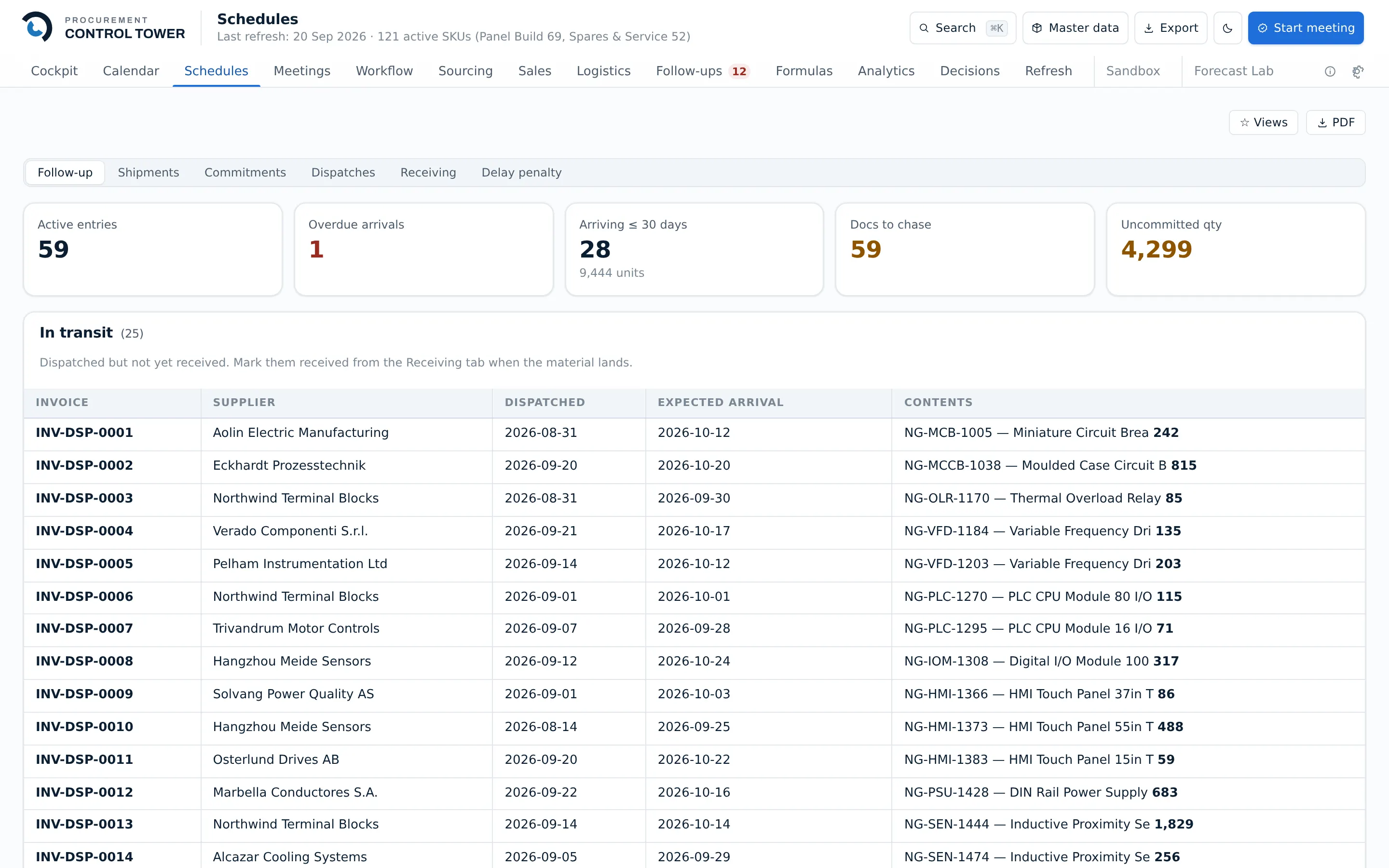
A schedule reference is built against the purchase order:
HALDEN/SR-9001, PO 4512088, 2,800 pieces, committed
to dispatch on 30 June 2026. That date is the one
every later question is asked against.
It joins 59 other live commitments. 28 of them are due inside 30
days, carrying 9,444 pieces; one arrival is already overdue; 59 are
still waiting on documents. None of that is anyone's memory.
Procurement Control Tower — Schedules
Step 14 of 19
Expediting, as a queue rather than a memory
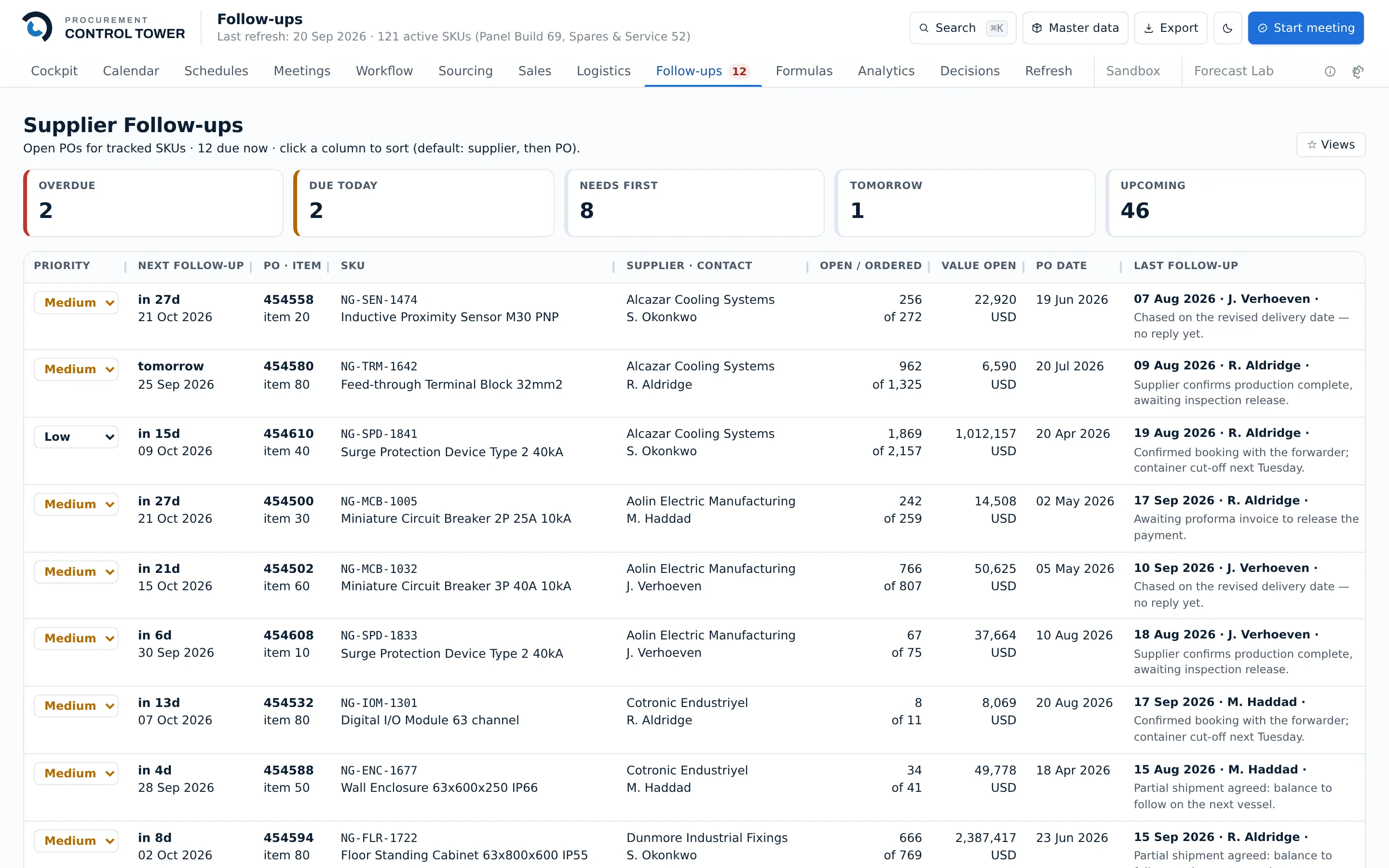
Two follow-ups are overdue, two are due today, and eight open orders
have never been chased at all. Each row carries the purchase order,
the part, the supplier's own contact, how much is still open and what
it is worth — and the last thing that supplier actually said,
with the date and the person who logged it.
“Chased on the revised delivery date — no reply
yet.” “Supplier confirms production complete, awaiting
inspection release.” “Partial shipment agreed: balance to
follow on the next vessel.” Three months later, that is the
difference between a claim and an argument.
Procurement Control Tower — Follow-ups
Step 15 of 19
The date moves. The liability does not.
Halden's own coil supplier is short, and the confirmed dispatch date
moves. Recording that is not just editing a date: the revision is
classified as a supplier delay, a
buyer hold, or force majeure, and
that choice is what decides who carries the cost.
This one is a supplier delay, with the reason recorded — coil
shortage at the sub-supplier, revised date confirmed in writing. So
the committed dispatch date moves to keep the plan honest, and the
penalty basis date stays on 30 June. Every later calculation measures
from the original promise.
Step 16 of 19
Dispatched, against the commitment it settles
Invoice HAL-2026-4471, dispatched and invoiced on 28 July 2026,
2,800 pieces of NG-BUS-1795. The invoice is entered once and
allocated against the commitments it settles — one shipment can
carry several parts against several schedule references — and
the app works out the consequence: 28 days late.
Step 17 of 19 · same record
Received — which is what finalises it
Marking the shipment received closes the line. Until that happens the
delay is still running: an undispatched commitment accrues against
today's date, and the amount grows daily. The receipt is what turns
a moving number into a final one.
Step 18 of 19
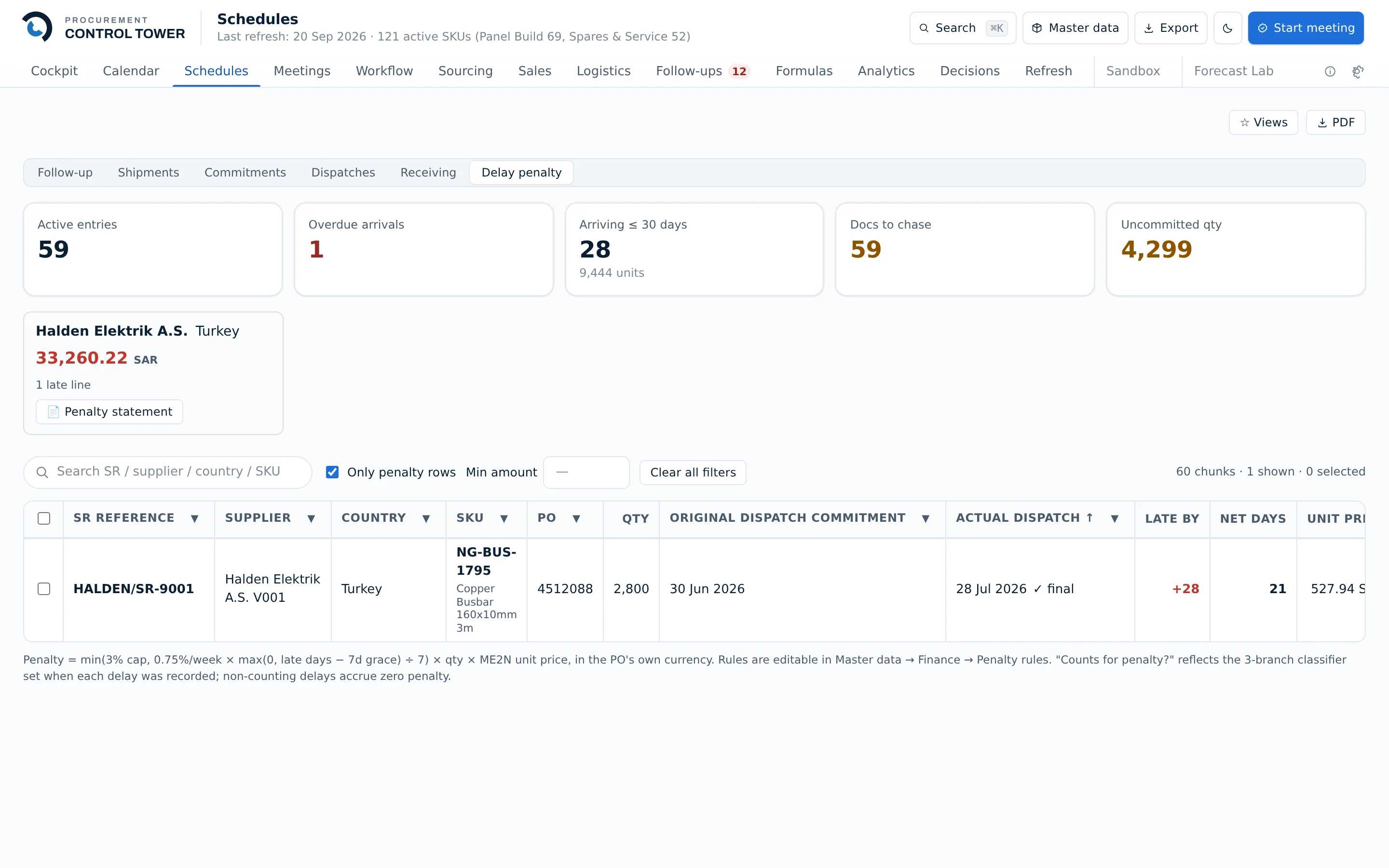
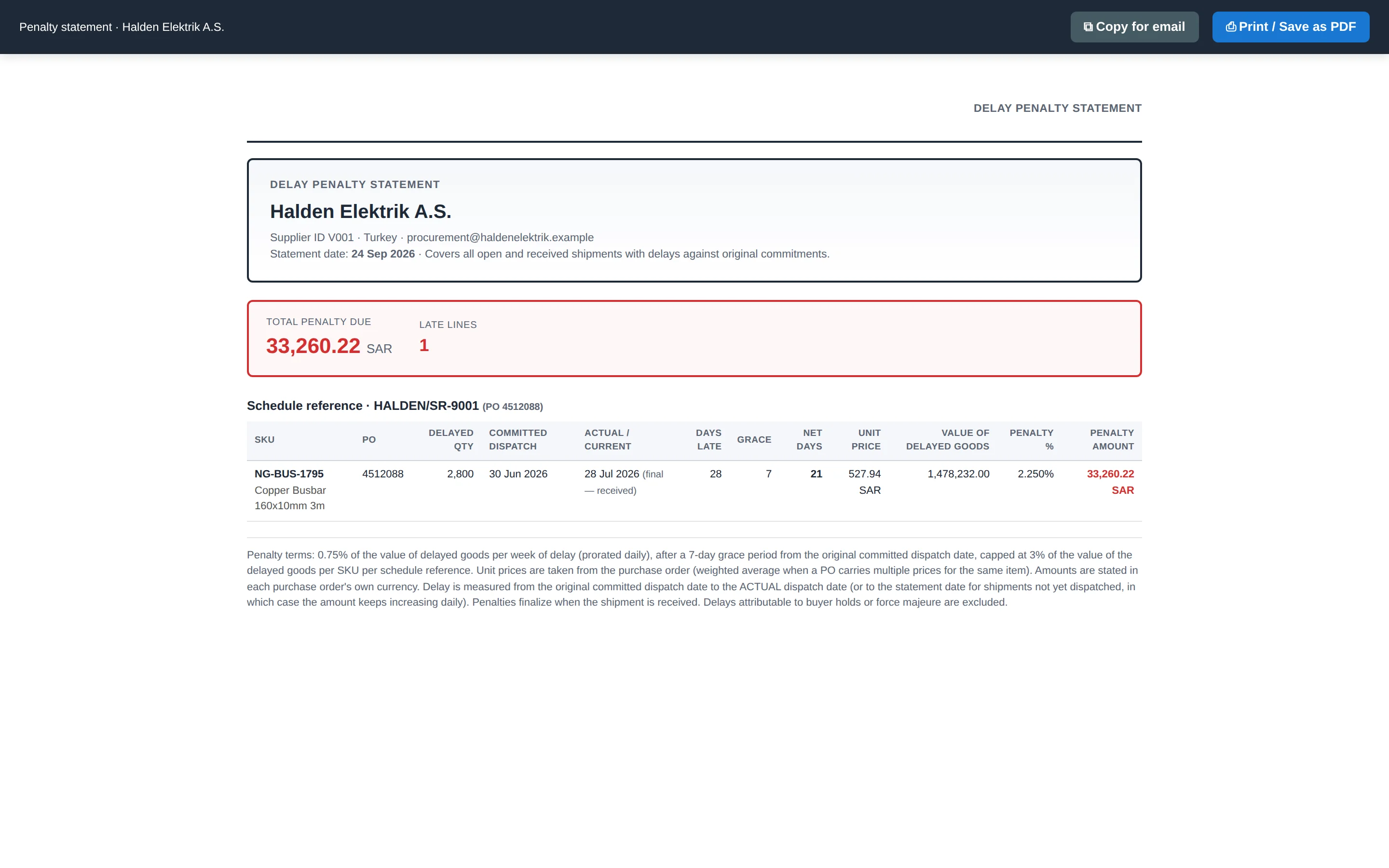
The clause most companies track by hand
Nearly every supply contract has a liquidated damages clause, and
nearly every team tracks it in a spreadsheet — late, partially,
or not at all. Not because it is hard arithmetic, but because the
four numbers it needs live in four different places: what was
committed and when, what actually shipped and when, how much of it,
and at what price.
Here they are already in one system, so the clause is entered once
— 0.75% of the value per week, seven days' grace, capped at 3%
— and it calculates itself, per part, per schedule reference,
in the purchase order's own currency.
2,800 × 527.94 = 1,478,232 SAR of delayed goods. 28 days late,
less 7 days' grace, is 21 net days; 0.75% × 21/7 is
2.25% — under the 3% cap, so the proration is
doing real work. 33,260.22 SAR.
Procurement Control Tower — Schedules, Delay penalty
It comes out as a document, not a screenshot: the supplier, the
schedule reference, the purchase order, the arithmetic line by line,
and the terms it was calculated under, ready to print or to send.
Value delayed
1,478,232
Days late
28
Net of grace
21
Damages due
33,260.22
Step 19 of 19
The same work, added up
Eighteen steps for one requirement. The nineteenth is what happens
when a year of them accumulates: the same records, read as a whole,
with nobody rekeying anything to produce them.
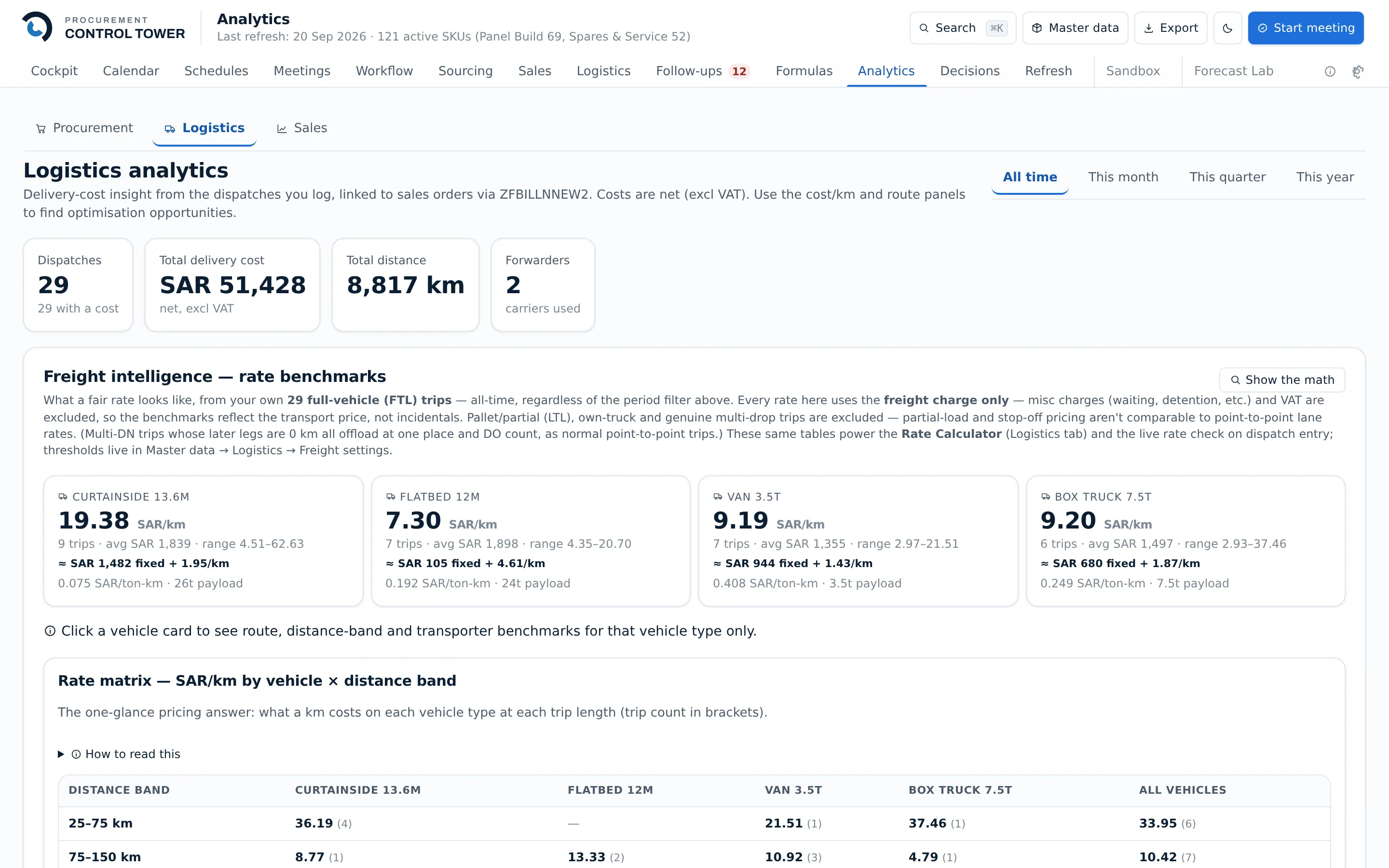
On the logistics side, 29 delivery trips costing 51,428 SAR over
8,817 kilometres with two carriers — and, from those trips
alone, what a kilometre actually costs on each vehicle type and at
each trip length. That is a rate benchmark built out of the company's
own freight invoices rather than a number a forwarder quoted.
Procurement Control Tower — Analytics, Logistics
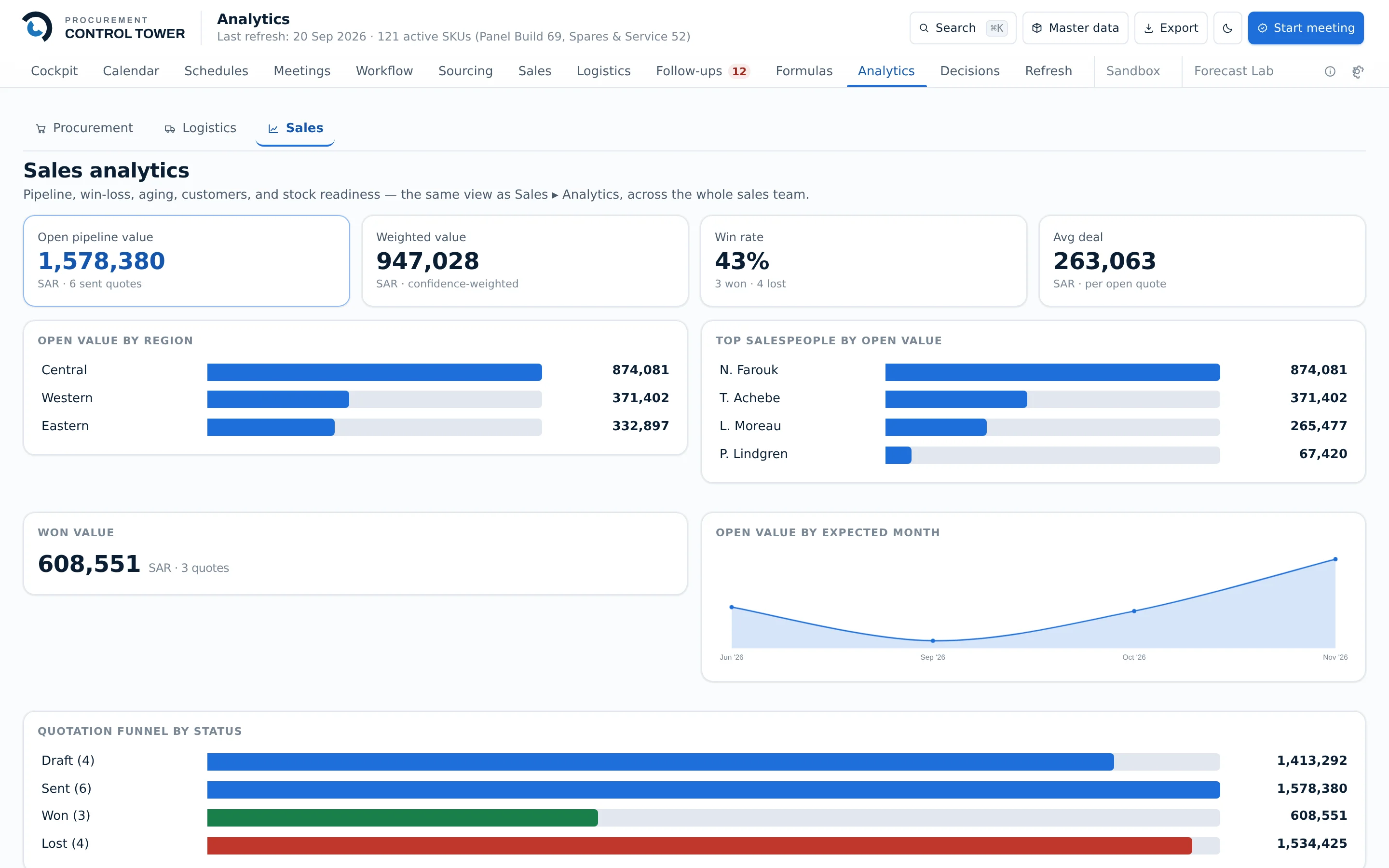
On the sales side, the other end of the same stock: 1,578,380 SAR of
open pipeline across six sent quotations, weighted to 947,028 by
confidence, a 43% win rate and 608,551 SAR already won — broken
down by region, by salesperson and by expected month.
Procurement Control Tower — Analytics, Sales
That was one line of one purchase order.
Nineteen steps, one reference, and every figure on this page produced
by the software from the same example dataset — so the
arithmetic survives being checked, which is the only kind worth
showing.